Showing posts with label Film. Show all posts

Saturday, 3 December 2011

THRIVE- a must see film

What on earth will it take?

"What happened that could account for the staggering agony and deprivation on this planet?Is it even possible for humans to thrive?" Foster Gamble 

The film THRIVE aims to answer these questions and to lift the veil on what's REALLY going on in our world by following the money upstream and uncovering the global consolidation of power in nearly every aspect of our lives. It weaves together breakthroughs in science, consciousness and activism, offering real solutions, empowering us with unprecedented and bold strategies for reclaiming our lives and our future. The trailer suggests that we can bypass the big corporations who seem to hold all the power and wealth in this world. They suggest that we can do this because there is in fact a model to access energy in a clean, safe and limitless way that could revolutionise the way that all people live. There is another way. THRIVE simply aims to lift the lid on this previously suppressed but mind blowing knowledge- that there is a code, a pattern in nature that has been embedded in arts and icons throughout the centuries that could enable us to have access to limitless energy and therefore to transform the way that we liveRead more about this key/the code called a Torus here and see Foster Gamble speaking about it below:


He says that The code is a pattern in nature that exists everywhere from atoms to galaxies. It's called a "torus."  You can see it in a seed, a fruit, a hurricane, even the electromagnetic field around a person or the earth.  It's how life sustains and evolves itself, and it serves as a universal template for sustainability in all our systems.
Among other things, the code shows us how to access clean, abundant energy, expand our consciousness, restore health and balance to the planet and live sustainably.
In this section of the site you can explore:
  •  how the torus reveals the structure and flow of universal energy;
  •  how ancient cultures embedded their knowledge of the code;
  •  how new energy inventors are using the code to power revolutionary devices  that can change how we live.
Here is a lovely interview of Foster Gamble by Lilou Mace on here JUICY LIVING tour.

Hmm many things to think on..... how exciting that people are waking up!!

Wednesday, 3 November 2010

"Every day in life is beautiful"


" I love people, i love everyone"

Alice Herz-Sommer at 107 years old this year is the oldest Holocaust survivor in the world and although an internationally renowned pianist for more than eighty years, she has recently re-entered the public consciousness. A few years ago thanks to the biography " A Garden of Eden in Hell"  published well past her 100th birthday and this year due to a new documentary short directed by Oscar winning director Malcolm Clarke called "Dancing Under the Gallows". The documentary examines the Czech-born musician's remarkable life and shows that although her life has been defined by her survival of the holocaust it has never, to her eternal credit, dimmed her vivacity or optimism. Alice Herz Sommer plays Chopin and speaks of how music helped maintain a sense of hope and humanity in the Nazi ghetto of Theresienstadt/Terezín near Prague which was home to a remarkable array of renowned Czech musicians, composers and theatrical artists, writing and performing as they and their fellow Jewish inmates awaited an unknown fate in Auschwitz. Ahead of a London concert to commemorate their lives and work, Ed Vulliamy also talks to some of the survivors who remembered them.


Alice Hetz-Sommer was born in 1903 into a Jewish, acculturated and German-speaking family in Prague. She started playing the piano at a very young age, and at 21, made her debut as soloist with the Czech Philharmonic Orchestra. In 1931 she married Leopold Sommer and their son Stephan (later to be called Raphael) was born in 1937. With the Nazi occupation of Czechoslovakia in 1939 their lives changed swiftly, with humiliating restrictions being imposed on Jews day after day. And then the deportations began. First, in July 1942 her 72-year old mother was deported from her Old Age Home to Theresienstadt (and from there to the Treblinka death camp). Then a year later, in July 1943, it was the turn of Alice, Leopold and Stephan, then aged six, to be sent to Theresienstadt. The physical conditions there were grim, but a few months before the Sommers arrived, the SS had decided to turn it into a `show camp' for observers from the International Red Cross - and so the deportees were provided with musical instruments (which had been confiscated from Jews) and were allowed to arrange their own entertainment. Alice gave many recitals and Stephan, who was musically even more precocious than his mother had been at that age, was quickly roped in to rehearse and perform in Brundibar, the opera specially composed for the children in the camp.


As defeat for Germany drew nearer in the autumn of 1944, the SS, possibly fearing an uprising of the able-bodied men in Theresienstadt, decided to send them to the extermination camps. Alice's husband was among these: she never saw him again. She learnt later that he had survived the death-march from Auschwitz to Dachau - only to die there of typhus.
But Himmler still wanted to preserve Theresienstadt as a `model' camp and to produce it in his defence at the end of the war. Alice had to work an eight hour day in barracks where slates were broken up to make insulating materials, work which was particularly hard on her hands; but in the evening she would often perform in the concerts that continued to be staged. In May 1945 Theresienstadt was liberated and in mid-June Alice and Stephan were able to return to Prague and to continue their music and lives there.

(If you want to see the finished film early next year please email: dancingunderthegallows@gmail.com )

Sunday, 31 October 2010

How do we inspire ourselves&others to greatness


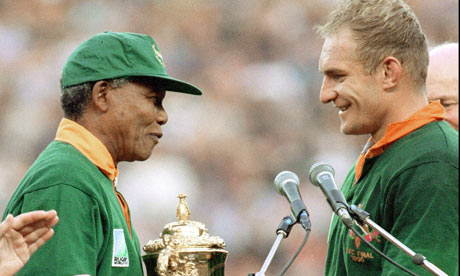
I saw the film Invictus ( meaning undefeated or unconquered), this weekend and was left truly inspired by the events portrayed and by the film's soul. It tells the story of how Nelson Mandela harnesses the power of rugby to unite South Africa. With the country due to host the 1995 Rugby World Cup in a year's time, the once imprisoned, now newly elected President, Nelson Mandela (Morgan Freeman), hits on the idea of using the national rugby team as a way to ease racial tension and unite the country. The captain of the struggling South African national team, Francois Pienaar (Matt Damon), is called to meet the President and soon realises that victory at the World Cup would transcend rugby, and could lead to something monumental for his country.


Quoting directly from the Wikepedia site:

 "After 27 years in Robben Island prison, Nelson Mandela (Morgan Freeman) is released in 1990 and works immediately to bring about the end of apartheid and the initiation of full democratic elections. While Mandela attempts to tackle the country's largest problems—crime and unemployment, among many others—he attends a game of the Springboks, the country's rugby union team. Mandela recognizes that the blacks in the stadium cheer against their home squad, as the Springboks (their history, players, and even their colours) represent prejudice and apartheid in their minds, and remarks that he used to do the same thing on Robben Island. Knowing that South Africa is set to host the 1995 Rugby World Cup in one year's time, Mandela convinces a meeting of the newly-black-dominated South African Sports Committee not to change the Springboks' name and colours. He then arranges a meeting with the captain of the Springboks rugby team, François Pienaar (Matt Damon). Though Mandela does not verbalize his true meaning during their meeting, Pienaar understands the message below the surface: if the Springboks can gain the support of non-white South Africans and succeed in the upcoming Rugby World Cup, the country will be unified and inspired to exceed its expectations. Mandela also shares with Pienaar that a poem, "Invictus", had been inspiring to him during his time in prison, helping him to "stand when all he wanted to do was lie down".


"Pienaar and his teammates train, but the players (all but one are white) voice disapproval that they are to be envoys to the poor and public, fearing exhaustion from overwork. Mandela, too, hears disapproval from friends and family. Many more, both white and black citizens and politicians, began to express doubts on using sport to unite a nation torn apart by some 50 years of racial tensions. For many non-whites, especially the radicals, the Springboks symbolised white supremacy and they did not want to support their national team."


"Things begin to change, however, as the players interact with the locals. During the opening games, support for the Springboks begins to grow among the non-white population. By the second game (which is in fact the quarter-final against Western Samoa) Williams is fit once again. Citizens of all races turn out in numbers to show their support for the Springboks. At the suggestion of several security guards, Mandela sports a Springbok jersey with Pienaar's number 6 on it to show his support, and his name is chanted repeatedly by the home crowd during his entrance, a contrast to a previous rugby match scene, in which Mandela is booed by some in the crowd. As momentum builds, even the security team members become at ease with each other and the black members who were not interested in the sport, eventually began to enthusiastically support their national team alongside their white colleagues.

 Prior to the game, the Springbok team is taken on a trip to Robben Island, where Mandela spent nearly 30 years in prison. There, Pienaar is shown Mandela's cell and has a vision of Mandela among the inmates. Later that night Pienaar mentions his amazement that Mandela "could spend thirty years in a tiny cell, and come out ready to forgive the people who put [him] there."


Invictus
William Ernest Henley


Out of the night that covers me,

Black as the Pit from pole to pole,

I thank whatever gods may be

For my unconquerable soul.

In the fell clutch of circumstance

I have not winced nor cried aloud.

Under the bludgeonings of chance

My head is bloody, but unbowed.


Beyond this place of wrath and tears

Looms but the Horror of the shade,

And yet the menace of the years

Finds, and shall find, me unafraid.


It matters not how strait the gate,

How charged with punishments the scroll.

I am the master of my fate:

I am the captain of my soul.


This film is truly inspiring and just reminds me that the seemingly impossible is possible when you have true faith and unwavering conviction.

"I am the master of my fate, i am the captain of my soul"


Monday, 18 October 2010

Babies


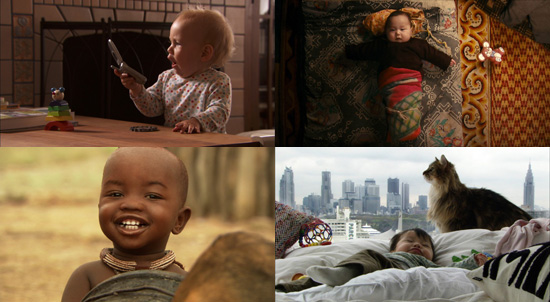
I absolutely love the trailer for the visually stunning documentary film  BABIES ,written and directed by Thomas Balmes. A father of three young children himself he wondered, "How do babies in vastly disparate cultures do this differently in their first year of life?".  The film simultaneously follows four babies around the world - from first breath to first steps.  The children are, respectively, in order of on-screen introduction: Ponijao, who lives with her family near Opuwo, Namibia; Bayarjargal, who resides with his family in Mongolia, near Bayanchandmani; Mari, who lives with her family in Tokyo, Japan; and Hattie, who resides with her family in the United States, in San Francisco. BABIES joyfully captures on film the earliest stages of the journey of humanity that are at once unique and universal to us all.

.
Thomas Balmes says that "The idea was not to pick families in poor countries, but families in countries that are different in their level of technology," says the director, 40, who lives in Paris. "I chose families that were happy, and who were positive about the arrival of a baby."


"Everything we do [in the Western world] is not the only way," says Balmes. In fact, there are downsides to our ways, as the film shows: we might overstimulate babies with too many toys; we might ignore them during play by talking on our cell phones and not being present to them. If there is one main theme, he says, "It's that we can see how kids do well with very little," when it comes to material goods, like toys -- or even a parent's constant hovering presence. These babies are endlessly interested by what is around them -- an insect, a breeze, a puppy's tongue. As Balmes says, "Sometimes very little can be enough."

Monday, 30 August 2010

The Beautiful Green

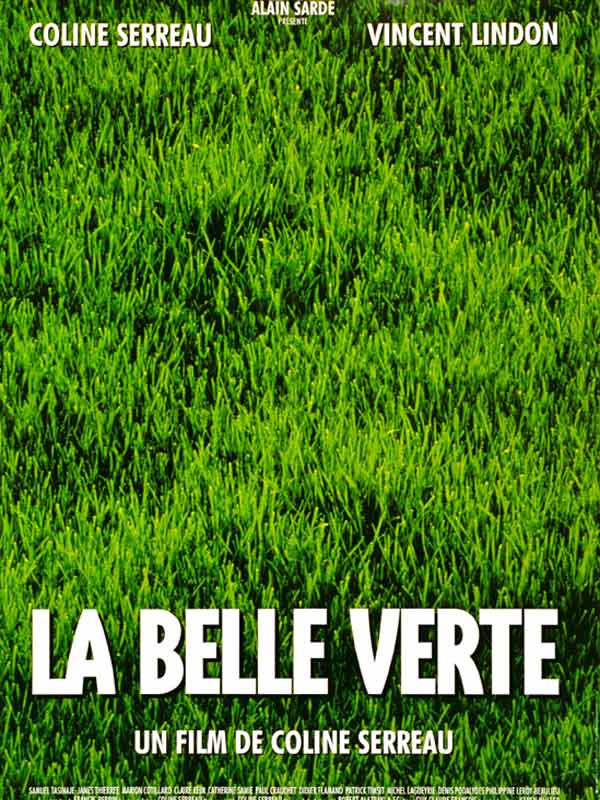
La Belle Verte

Finally, a film that presents the quirks of our modern and frantic living in a very humorous and simple way. This film doesn't "try" to make you laugh, you just do so because you can see yourself in it. La Belle Verte/The Beautiful Green (1996) is a French film written and directed by Colin Serreau which tells a beautiful story strongly encompassing the need to bring a spiritual balance of ecology, love and compassion to today’s world. It is about awakening and reawakening to ourselves and to what is important in life. We have become so disconnected from the earth and from ourselves and somehow we need to find a way back, to find a balance and perhaps to simplify things or at least to realise some simple truths. Originally in French, the film's protagonist is Mila who is half earthling and half alien! She lives on a planet far away from ours which is much more spiritually advanced and ecologically balanced than ours. They have already been through, and survived, an industrial revolution, different political systems, borders and money among other things and have ended up being a spiritually advanced race of peace loving raw fooders, skilled in the arts of telepathy and teleportation. The alien planet wants to send a representative to Earth to check on its developments and gauge the energy levels there. 


They send Mila who is 150 years old and has five children; encoded in her brain are two telepathic programs designed to restructure the thinking of destructive humans. The first is a fairly mild program designed to inspire the humans to rethink their world and begin asking some difficult questions. The other is far stronger and rapidly indoctrinates subjects with lofty utopian ideals and makes them deeply aware of themselves.


Mila lands in Paris and is unnoticed but for the sudden, inexplicable power surges and outages that occur whenever she sends a telepathic message to her alien cohorts. Instead of eating, Mila draws energy from holding newborn babies.It is while holding an orphan infant in an obstetrics ward that her Earthly troubles begin. Feeling deeply for the baby's plight, she confronts the ward's head doctor and when logic fails, lets one of her programs work on him. He sees the light and begins helping her to save the baby from the welfare workers. He reawakens to the beauty in life. 

You can see the whole thing on YouTube here or buy the Dvd on amazon here.  Please stick with this utterly amazing (must see) film that highlights the many unfortunate flaws of the Human race. As well as being extremely funny, it's incredibly insightful and thought provoking. 


Thursday, 27 May 2010

Once....is all it takes


I saw the film ONCE this evening and completely fell in love with it and the music.

One of my favourite songs from the film is "Falling Slowly"  It reminds me that that i am so lucky to have experienced great love in my life and the fact that i am with my greatest love, my darling husband is just the best thing ever. I think huge inspiration can be found within love and within a great relationship. This april my husband and i celebrated 10 years of being together and it will be 3 years this year of being married. It is a great love affair and i never want it to end. I remember the first moment when i fell in love with him, or when i realised that i had, as there were many moments where i seemed to wake to the light and warmth and love in him. He was the first man who i could be completely myself with and with whom i felt home. He was the first man who i felt truly saw me. Friends have asked when was the moment that we realised we were together, that we were a couple. Well we never talked about it, it just was, it just happened because it felt right and although there have been difficult times we have always come through it because of this deep love, connection and crucially a sense of humour. He is the best person to have a giggle with and to make me laugh at myself.......thank god! Thank you Andreas i love you with all my heart.

Wednesday, 26 May 2010

Nothing is impossible when you believe in magic


To take risks and to do things that are life affirming, that make us feel more alive, more here, more in our bodies is crucially important. Without taking some kind of risk in life we would not progress, grow or improve. We don't of course need to risk our lives in order to experience these things but in some way they will be things that will stretch us, challenge us and concentrate us, bringing us back to ourselves and importantly allowing the movement that life needs in order to continue.


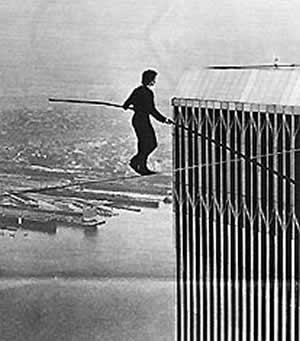
Coming across the trailer for the film  "Man on Wire" where Phillipe Petit walks between the Twin Towers on a wire,  i realise that sometimes we have to push ourselves to truly feel alive. To take this kind of risk obviously brings one face to face with death but also ultimately with life. It is inspiring, exhilirating and makes one believe that anything is possible if one believes and wants something enough. There are really no barriers, just illusions.

Man on Wire trailer: http://www.youtube.com/watch?v=W5aGddaC-gQ

Sundance Festival interview: http://www.youtube.com/watch?v=9vztE8eeYFE&feature=related

Friday, 5 March 2010

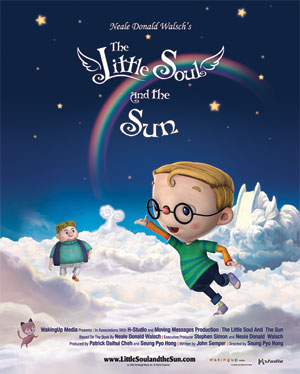
The Little Soul and the Sun


"The Little Soul and the Sun"  is a wonderful children's parable, adapted from the book "Conversations With God", by Neale Donald Walsch. I feel that it has a beautiful message about who we are, for everyone. 

Here is a wonderful review of the book taken from Amazon:

"This beautiful story is illustrated in lavish pastels by Frank Riccio, and features a parable about Little Soul--one who wants to experience itself as Who I Am. You see, Little Soul knows that it is Light--but feels that knowing isn't enough. So Little Soul asks God if it can actually feel what is means to be the Light. So God asks Little Soul how it can experience the Light when it is already as a candle in the Sun, along with the other billions of souls who make up the brilliance of the Sun? Little Soul entreats God to think of something--some way in which it can experience what it feels like to be Light.

God answers Little Soul "Since you cannot see yourself as the Light when you are in the Light, we'll surround you with darkness." Little Soul asks "What's darkness?" and God replies "It is that which you are not." Little Soul asks God if it will be afraid, but God says "only if you choose to be...there is nothing, really, to be afraid of, unless you decide that there is."

One of the central themes of "Conversations with God" is that in order for God to experience Itself, it had to be contrasted with something else, something "other". You cannot experience dark without light, up without down, now without then, fast without slow. The purpose of duality is to experience parts of the God-self in all its glory. In a sense, we are all a part of God, and God exploded into a million Souls to experience Itself.

However, when we made the journey Earthward, we forgot where we came from and who we were. The Little Soul and God continue the conversation, and talk about how everyone is special in their own way, each manifesting a different part of "special". Some parts of special include kindness, creativity, and patience. Little Soul decides that the part of "special" it wants to experience is the part of special known as forgiveness. A multitude of Souls gather around God and Little Soul to hear this extraordinary conversation, and God sweeps an arm towards them: "There is nothing to forgive" God says. Little Soul could hardly believe what God said. "Everything I have made is perfect. There is not a single soul in all of creation less perfect than you. Look around you."


Little Soul grumbles that this wasn't fun at all! How would it experience itself as One Who Forgives if there was noone to forgive? Just then, Friendly Soul offers to help him, volunteering to come into Little Soul's next lifetime so it can do something for Little Soul to forgive. Little Soul was incredulous, and aks why Friendly Soul, who was such a magnificent Being of perfect Light, would want to become dense and dark, slowing it's vibration in order to do this bad thing for Little Soul to forgive? "Simple", The Friendly Soul replies. "I would do it because I love you." Friendly Soul goes on to explain that both it and Little Soul have been male and femaile, good and bad, victim and villian, All of It. "Thus have we come together, you and I, many times before; each bringing to the other the exact and perfect opportunity to Express and to Experience Who We Really Are."
In being the "bad one" this time around, Friendly Soul will give Little Soul the opportunity to experience itself as One Who Forgives. Friendly Soul becomes serious and confirms that it will have to become dense and dark to do this act and that both it and Little Soul may forget Who They Were. Friendly Soul asks Little Soul a favor: to remember, in the moment that it strikes and smites Little Soul, doing the worst that it can possibly imagine, that Little Soul will remember Who Friendly Soul Really Is.

An agreement was made, and Little Soul goes forth into a new lifetime, excited to be the Light, and to experience that part of "special" called Forgivness. "...whenever a new soul brought joy or sadness--and especially if it brought sadness--the Little Soul thought of what God had said. 'Always remember', God had smiled, 'I have sent you nothing but angels.'"

My favorite passage of the book, which is the major theme of the New Age, is:

 "And so", God concluded, "when you are surrounded with darkness, do not shake your fist and raise your voice and curse the darkness. Rather, be a Light unto the darkness, and don't be mad about it. Then you will know Who You Really Are, and all others will know, too. Let your Light so shine that everyone will know how special you are!"

Take a look at The Little Soul and the Sun's - official trailer, the DVD excerpt and the book


 Let your light shine


Thursday, 11 February 2010

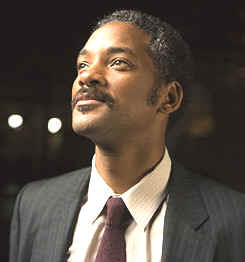
Will's Wisdom


In this short video the actor Will Smith talks about his path to success and happiness. It is definately inspiring stuff. He believes you make your own luck and success by working very hard and dedicating yourself to be being better every day, to developing your skill- "greatness is in all of us ".... he is living proof that that is the case and i think he's pretty cool because of his positive ( magnetic) energy and belief in himself.
His father told him 'Don't ever tell me there is something that you can't do. If you want something go and get it. You don't set out to build a wall, you say i am going to lay this brick, just one brick as perfectly as i can and i'm going to do that every day, then you will eventually have a wall.'


If you haven't seen his film In Pursuit of Happyness it is definately worth the watch. Make a choice, decide who you are going to be and what you are going to do. You have to focus, but you will make it it if you believe in something enough. You can create whatever you want to create.
Related Posts Plugin for WordPress, Blogger...